Showing posts with label webservices. Show all posts

Thursday, July 3, 2014

Vaadin 7 + Spring 3 + JPA project summary and lessons learned

This blogpost is a short summary of the Vaadin 7.0 project I did last year, including tools used, lessons learned and a bunch of screenshots to show the results.

Tools used

  • Spring 3.2 including annotation based configuration, Spring Task*Executor framework
  • JPA2 with Hibernate 4.2 + JPA modelgen, including Envers for auditing
  • JMS 2
  • Vaadin 7.0.1
  • JAXB 2.1
  • Spring WS 2.1
  • Shiro 1.2
  • JUnit 4.8
  • Mockito
  • Eclipse 3.7
  • SOAP + SoapUI
  • MySql 5.5 + H2
  • Tomcat 7
  • Jenkins
  • Fisheye/Crucible
  • Sonar
  • Subversion
  • Maven 3
  • Java 6

Lessons learned

  • Don't only trust SoapUI of being able to validate your WSDL. Also try to generate stubs with Axis2 and JAXWS generators. *AND* actually make sure you can make a call to the webservice, because on our project it did work perfectly fine in SoapUI, but not in Axis nor JAXWS. Example: soap fault in operation but not in porttype defined. It required the project to defining one or more xyz.jaxb files for JAX-WS  (using .episodes dit not work for us). Then use these in the wsimport etc. Related links: Compiling multiple WSDLs that share a common schema and Customizing Java Packages.
  • If sources not found of e.g junit-4.11 (junit.org is also giving a lot of 404s), then run mvn clean dependency:sources, that will download the sources too into the .m2 repo.
  • Try to keep the WSDL and XSD as semantic as possible, so use Strings instead of IDs for for example lookup /reference values like: started, finished. Makes the interface much more readable and understandable by just looking at it.
  • count(case ...) is NOT supported by Hibernate criteria API, when using it it gives: java.lang.IllegalArgumentException: org.hibernate.hql.internal.ast.QuerySyntaxException: unexpected token: case near line 1, column 92 [...  Use sum(case) since that is supported.

    So instead of:

    cb.count(cb.selectCase().when(cb.equal(workOrder.get(WorkOrder_.priority), 1), workOrder.get(WorkOrder_.priority)).otherwise(0)),
    Use:

    cb.sum(cb.selectCase().when(cb.equal(workOrder.get(WorkOrder_.priority), 1), 1).otherwise(0)) 

    SQL equivalent:

    Instead of:

    COUNT(CASE WHEN priority = 1 THEN priority ELSE NULL END) AS prio1,

    Use:

    SUM(CASE WHEN priority = 1 THEN 1 ELSE 0 END) AS prio1,

    Links about this:

    https://forum.hibernate.org/viewtopic.php?f=1&t=992497
    https://forum.hibernate.org/viewtopic.php?p=2393060
    http://stackoverflow.com/questions/11011151/jpa-criteria-query-order-by-enum-values
    Sums replacement for count
    JPA 2.0 spec including 'case expressions' and this one and this one.
    http://stackoverflow.com/questions/775787/plsql-get-sum-for-each-day-of-week-and-total-sum-for-week-in-a-single-query
  • When trying to upgrade from Vaadin from version 7.0.1 to 7.0.4 by updating the version number in the pom.xml, a serial UID problem occurred when generating the widgetset for this new version:

    [INFO]  at com.google.gwt.dev.Compiler.main(Compiler.java:177)
    [INFO] Caused by: java.io.InvalidClassException: com.google.gwt.dev.jjs.ast.JMethod; local class incompatible: stream classdesc serialVersionUID = 5017484276333252513, local class serialVersionUID = 9103713597467037978

    Tried it then with 7.0.2, that one worked fine! 7.0.3 gave the same error. This post talks about maybe the GWT cache being the problem. So I deleted the directory (even though the timestamp on that directory was recent!) and that worked. In my case the directory to delete was:

    D:\workspace\xyz\frontend\app-web\src\main\webapp\VAADIN\gwt-unitCache 

The application

Below you can find a bunch of screenshots of the resulting application Planning Optimizer or ePOp.


The login screen, authentication via Shiro with a custom Realm that does a SOAP call to the backend:


The dashboard so the planner can immediately see the status + what needs attention first:

The Vaadin Charts 90 days look ahead graph shows the status for the coming 90 days. Clicking on a bar shows the orders at the bottom table for that day. A similar 12 weeks graph is available on another tab:

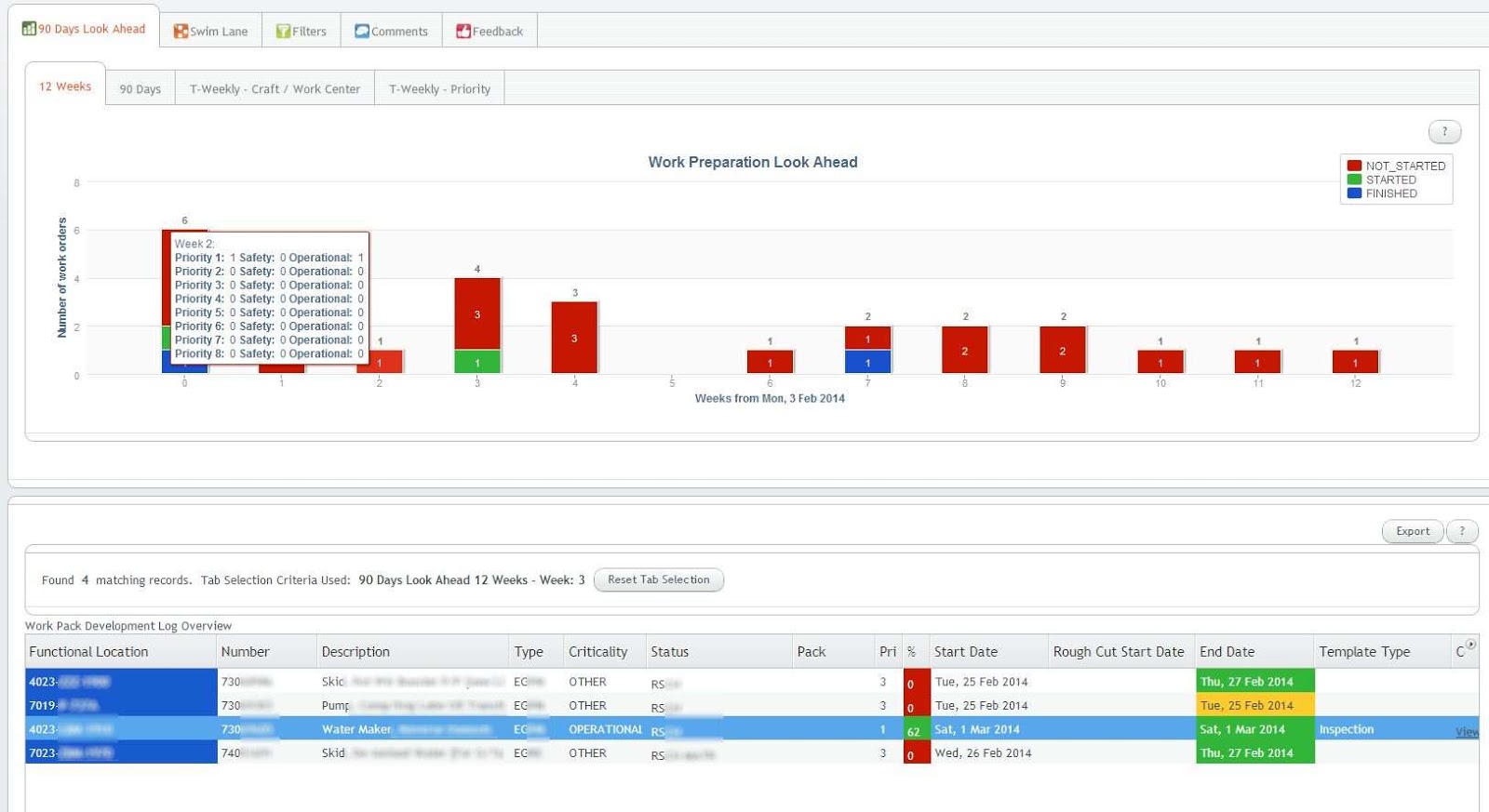

Different ways of looking at the status exist, for example these week-based graphs, the first one based on craft, the second one on priority:
Notice in the above graph the multiple y-axis: the bars are for the left y-axis, the lines for the right y-axis.

And other filters:


When clicking on a row in the bottom table, details for that order can be filled in:

Links (from a whitelist) and documents can be attached too (including drag 'n drop), and in the end a PDF can be generated with all the info (including the attachments + where the links are pointing to!) included:

Sunday, August 8, 2010

Best of this Week Summary 2 August - 8 August 2010

Sunday, March 28, 2010

Best of this Week Summary 22 March - 28 March 2010

Sunday, March 7, 2010

Sunday, February 14, 2010

Best of this Week Summary 8 February - 14 February 2010

  • Five new features of Spring 3.0 described:

    • Spring Expression Language (SpEL)

    • Object/XML Mapping (OXM) module

    • Type-conversion system

    • Formatter SPI

    • RESTful web services support

    What new Ajax simplifications have been introduced can be found here.

  • The Java EE 6 web tier introduces with Servlet 3.0 spec the ability for asynchronous processing of requests so that the thread may return to the container and perform other tasks. It also "adds annotation based configuration (@WebServlet, @ServletFilter and @WebServletContextListener) making the web.xml file optional, and introduces a new concept of web fragments."

  • Introductionary article to Apache Click. One difference between Click and Wicket is that Click is stateless by design, while Wicket is stateful. Both can be configured their "opposite" model, though these have their own pros/cons.
    Another main difference is that that Click uses templates (Velocity by default) where Wicket does not.

    Sidestep: here's a bunch of nicely designed Wicket sites that scale (note: not really clear where the scalability statements come from).

  • A 60 minutes presentation on how SOA is a hit at eBay.

Sunday, December 13, 2009

Best of this Week Summary 07 December - 13 December 2009

Sunday, November 22, 2009

Best of this Week Summary 16 November - 22 November 2009

Sunday, November 15, 2009

Best of this Week Summary 09 November - 15 November 2009

Sunday, September 27, 2009

Best of this Week Summary 21 September - 27 September 2009

  • Always feeling a bit less up-to-date when using RSS/Atom feeds? Well, convince your RSS/Atom provider to implement the PubSubHubBub protocol: it provides a callback-hook, which when registered to as feed subscriber, causes an immediate update (ping) to the subscriber (instead of waiting for the next RSS/Atom feed request).
    Or will rssCloud be the winner of this realtime RSS extension? Here's the basic (simpler) flow of rssCloud:


    Differences between the two are described here (including some issues) and here. A real old-fashioned flame-war has even started between the creators of the two protocols.
    And a good comparison which explains quite well why PuSH is the better choice of the two. Note that both protocols seem to be server-to-server only! (e.g think when you're behind a firewall or NAT...)
    See this article for an explanation of the PuSH flow of notifications/information in below's diagram:


    Update: PubSubHubbub explained by co-creator Brett Slatkin (an engineer at Google).

  • Want to get to know Hadoop? In short "Hadoop allows you to write and run your application in a distributed manner and process large amounts of data with it. It consists out of a MapReduce implementation and a distributed file system." Check the rest of this introduction for more details.

  • Five Java anti-patterns to prevent (out-of) memory problems.

  • Three Best and three worst practices in BPM and SOA.

  • "Tom Killalea, Vice President of technology with responsibility for infrastructure and distributed systems engineering at Amazon.com wrote an article on ACM queue on building scalable web services. He outlines guiding principles to building scalable web services with a lot of real-world examples, the core theme of which is “build only what you need”."

Sunday, September 13, 2009

Best of this Week Summary 07 September - 13 September 2009

  • Wondering whether you should add this new piece of functionality quick & dirty or take a bit longer, but cleaner? Taking the first one sets you up for a Technical Debt, as some more explained by Martin Fowler.

  • "Test logic can be buried in this unrelated code, which has nothing to do with test logic itself, making test code hard to read and maintain. In this article, the layered architecture of test automation is presented to solve this problem. In this layered architecture, the test automation code is divided into three layers: (1) test cases, focusing on the test logic of the application, (2) the domain layer, modeling the system under test in domain terms, encapsulating http requests, browser control, result parsing logic and providing an interface for the test cases layer, (3) the system under test, which layer 2 will operate directly on."

  • A good explanation of the Canonical Message Model in the context of an ESB, and why you'd need one within an SOA. Great description of different approaches for implementing a CMM in an ESB and their pros and cons.
    A short introduction to CMM modelling (data model and message model) is described here.

  • From The Open Group two free PDF books: "The Open Group SOA Integration Maturity Model (OSIMM) provides consultants and IT practitioners with a means to assess an organization’s Service Oriented Architecture (SOA) maturity level."
    "This document describes a framework that provides context and definitions to enable organizations to understand and deploy SOA Governance."

  • The JavaServer Faces 2.0 specification (included in JEE6) got finalised last May. Here's a reference to it and a set of references related to this specification.

Sunday, August 9, 2009

Best of this Week Summary 3 August - 9 August 2009

Sunday, March 29, 2009

Best of this Week Summary 23 March - 29 March 2009

  • Need to know whether a collection is modified concurrently, which causes the ConcurrentModificationException? Check this handy wrapper solution here.

  • The second article in the Transaction strategies series. "Using examples from the Spring Framework and the Enterprise JavaBeans (EJB) 3.0 specification, explained is how the transaction models work and how they can form the basis for developing transaction strategies ranging from basic transaction processing to high-speed transaction-processing systems".

  • For the Amazon EC2 now a free AWS Eclipse plugin is available. It facilitates remote development, deployment, and debugging Java applications on Amazon Web Services.

  • Three common mistakes to avoid when implementing XML and webservices: don't make your messages too large, don't create too fine-grained services, and don't forget to create an XML schema.

  • Javascript is getting more and more important the last couple of years, so here's a bunch of best practices and efficiency tips.

Sunday, February 1, 2009

Best of this Week Summary 26 January - 01 February 2009

Saturday, January 3, 2009

My clients are getting thicker and thicker: MVC implementation shift

Last week I stumbled over this interesting article on the potentially changing Model View Controller architecture implementations. (Sidenote: here's the more subtle distinction between MVC1 and MVC2 described. And here's an article on the ambiguity of the term and pattern MVC.)
An example logical diagram of MVC2 is shown below:


For quite some years, the general practice was to generate HTML as result of the View, with the browser rendering it and being the thin web client. These days though, more and more the web client is getting heavier ("fatter") because of all the Javascript being used for AJAX, SPI and, in general, more logic on the web client.
The article takes a look at the different approaches to MVC implementations:

  1. the HTML-only approach;

  2. the HTML+Javascript "basic" approach; some of the Model's "business logic" is duplicated on the client;

  3. the "AJAX" approach; partial views can be updated, the view consists of multiple HTML fragments, Javascript creates the View, not the application server;

  4. and the full-blown Javascript-only ("a la gmail") approach; Javascript in the browser creates the views, near-complete responsibility for the Model business rules in the web client (browser), the web client would be the Controller.

The approaches range from, at the one extreme end, the definitive "thin client", and at the other extreme end, the definitive "thick client"." Example frameworks that can easily facilitate the last option are Google Web Toolkit (Java to Javascript) and Pyjamas (Python to Javascript). Below GWT's architecture diagram is displayed. Note the (relatively) limited application server procedures, part of the Model, preferably only performing basic validation, security, etc.


The new MVC2 diagram for the above mentioned fourth approach would look something like this:

Included in the article is also how you could split up work in a team between people working on the View and Model parts.

I do not completely agree with the statement in the beginning of the article that says "The Web client takes care of keystrokes and mouse movements: the Web browser application itself is the Controller". I'm reading this as: the browser is the controller. Though, when you look at the first picture, that is not what the Controller is supposed to be.
But, in general the whole potential movement of going to thick clients is an interesting one to keep an eye on.
Other pros for thicker Javascript-based clients (not mentioned in the article) are:
  • Easier distribution of new versions than in the old days with fat clients like Visual Basic, where you had to make sure all clients got updated;

  • Easy opening up of your SOA webservices. The fat client could directly access them;

  • Easier mashup possibilities at the View layer via Javascript;

  • Potentially a large improvement in scalability: the client processing power is used as much as possible, the application server only performs several basic checks;

  • The Javascript generator/builder takes care of browser compatability.


Several cons are though:
  • Potentially quite significant longer page loading times when the Javascript all has to be loaded at once;

  • If not designed correctly, there could be significant extra network traffic;

  • Being dependent on the Javascript generator/builder when a browser is (not anymore) supported (though an opensource framework allows you to build it yourself if really needed).

Sunday, November 30, 2008

Best of this Week Summary 17 November - 30 November 2008

  • Interesting recent long discussion (with a bit of framework flame-war in between) and tips on when to pick what web client framework. Tapestry, Wicket, Stripes, GWT, Flex seem to jump out.

  • Interesting Javascript optimizer: Razor Optimizer. It dynamically analyzes the runtime profile information, trying to load each Javascript function only when needed, potentially creating 60-90% savings. It does require a client and server component. The question is: are you prepared to take a (small?) risk that your Javascript is dynamically modified?

  • Good article that explains why Scrum often fails as implementation of Agile. Lots of times Scrum is only seen as fast Sprints and Scrums. But: "Don't leave out the 'regular' agile good engineering practices". Check also the comments for good tips.

  • A good introduction to RESTful webservices.

  • Great, soapUI 2.5 now also suppports testing RESTful webservices. It includes testing JSON output.

Saturday, October 25, 2008

Best of this Week Summary 20 October - 26 October 2008

Sunday, April 27, 2008

Best of this Week Summary 12 May - 18 May April 2008

Best of this Week Summary 05 May - 11 May 2008

Sunday, January 27, 2008

Best of this Week Summary 21 January - 27 January 2008

  • Nice routing pattern for webservices that need to provide both synchronous and a-synchronous calls. You can even make the router such that depending on certain criteria (like load, response time), it will either turn the call into an a-synchronous call when needed. Disadavantage of this approach is of course that the caller has to be able to support both an a-synchronous and a synchronous version of each call. Related patterns you can find in these seven Self-Service: select application patterns.

  • An effort to give answer to the question whether Tomcat is an application server or not. GREAT introduction to JEE btw, so good read for beginners or as a refresher. The answer: Tomcat does not support the entire Java EE stack: no distributed transactions, EJBs, and JMS.

  • IBM made their Jazz tool available for the public. It can be used to "build a scalable, extensible team collaboration platform for integrating work across the phases of the development lifecycle." Note that it is not fully opensource yet. There's also a Mylyn connector available for Jazz.

  • Version 3.0.0 of HTML Purifier has been released. It will scan your HTML for malicious XSS code, check for compliance and will try to fix your code.

  • Summary of a statement made by Bruce Eckel in this article that Java should not change much anymore: it should stop growing and just become stable, and Sun should focus on optimizing/extending the JVM. Interesting considerations.

  • And finally for this week, for the developers among us, a bunch of shortcut keys in Eclipse you might not know about.

  • The Open Source hardening Project of the US Homeland Security department together with Coverity has led to the milestone where in 11 opensource projects all main bugs have been fixed. These 11 have been moved up to the new level Rung 2. Here you can see all the results of the scan.

Saturday, September 8, 2007

Best of this Week Summary 03 Sept - 08 Sept 2007

  • Good interview with IBM VP about BPM and SOA and how they are related.

  • Microsoft released Silverlight 1.0 and is also going to built a version for Linux, together with Novell. That version, based on Mono, will be named Moonlight. Some more reports of this news here and here. See my post from May for a quick overview of Silverlight vs AIR vs JavaFX vs Flash/Flex.

  • 6 interesting questions you should address when considering SOA. Questions range from security to ROI.